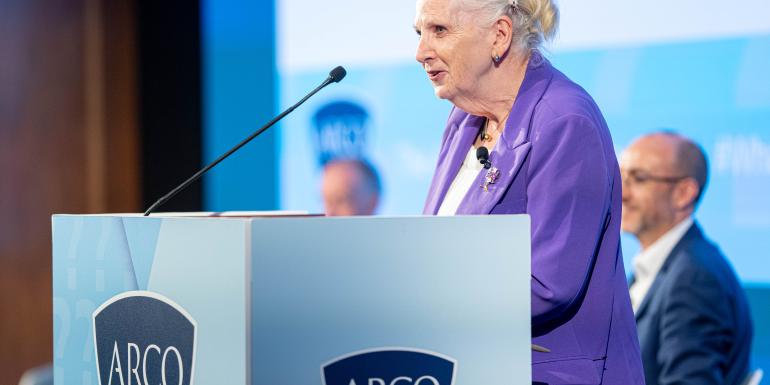
Baroness Taylor of Stevenage, Parliamentary Under-Secretary of State at the Ministry for Housing, Communities and Local Government spoke today (01 July, 2026) at the annual conference of ARCO – the national membership body for charity, not-for-profit and private operators of IRCs.
The Minister noted that Integrated Retirement Communities have an important role to play in offering people a more supportive environment as older people’s needs change over time, and the benefits extend across the health system, housing market and society as a whole.
Reflecting on the government’s commonhold and leasehold reform agenda, Baroness Taylor said:
“The government is committed to reforming leasehold and to making a reformed commonhold the default model of homeownership for new flats. These are significant, long-term reforms to deliver a fairer system for homeowners.
But we also recognise a simple point: That not all approaches to housing delivery are the same. And that is particularly true for your sector.
Integrated Retirement Communities bring together housing, care and community. They rely on long-term stewardship, with operators remaining involved over time, and funding models that often depend on returns realised later, including at resale.
That creates a genuine question with the commonhold model which is designed around homeowner control. We understand that.”
She continued:
“we have explicitly encouraged views on how commonhold should apply to older people’s housing, and whether different approaches may be needed generally, or for different parts of the sector.”
The statement from Baroness Taylor follows recommendations (27 May, 2026) from the Housing, Communities and Local Government Committee following its formal pre-legislative scrutiny of the draft Commonhold and Leasehold Reform Bill. The Committee noted:
“…the care model and complex financing of some retirement housing — particularly Integrated Retirement Communities — may justify a different approach to other leasehold housing.”
Michael Voges, Chief Executive, ARCO said:
“The feudal leasehold system is coming to an end. We believe commonhold is absolutely the right tenure for general needs flats.
However, for service-led housing-with-care for older people, commonhold poses some challenges.
Looking internationally, we don’t see other housing-with-care sectors using commonhold, but instead, contract-based tenure models are the norm, that simply don’t exist in the UK.
We are pleased that the government recognises different approaches to leasehold reform may be required for different parts of the older people’s housing sector – a view echoed by MPs on the Housing Select Committee.
That is why ARCO members are asking Ministers to enable the sector to use a bespoke Retirement Occupancy Lease model, which blends a new contract-approach with elements of leasehold and could be a stepping-stone to the kind of ‘occupational rights agreement’ used in New Zealand, which has been core to the growth of the sector and where two of the three largest housebuilders are IRC operators.”
NOTES TO EDITORS
-
ARCO is the national membership body for charity, not-for-profit and private operators of modern housing-with-care schemes, known as Integrated Retirement Communities (IRCs). ARCO provides a voice for the sector with government and sets standards for the sector via the ARCO Consumer Code, which has been approved under the Chartered Trading Standards Institute’s Approved Code Scheme. For more information, see: arcouk.org
-
IRCs are modern housing-with-care schemes for older people – modern because they embrace a holistic approach to services, facilities, community and wellbeing. All IRCs include:
-
24/7 on-site support
-
A restaurant/bistro/café, usually with a bar
-
Individual units with their own front door, kitchen and lounge
-
Communal facilities such as gyms, craft rooms, lounges and gardens
-
Personal care at home if it is required.
-
The average age people move into an IRC in the UK is around 80 and the average duration of residence is eight years. In addition to the features above, IRC operators offer deferred management fees (sometimes known as ‘event fees’ or ‘exit fees’) in order to enable lower monthly management fees and take on long-term responsibility for maintenance and investment. Unlike traditional retirement housing (which typically use variable service charges and a sinking fund), deferred management fees give operators a direct financial incentive in the resale value of a scheme ('skin in the game'). Independent evidence shows that the use of deferred management fees supports positive resale values.
-
Building on the lessons of New Zealand’s system of ‘occupational rights agreements’, ARCO has issued proposals for a ‘Retirement Occupancy Lease’ for the IRC sector, which would reorient the legal framework for the IRC sector away from static leases toward legal arrangements that can be updated for every new resident. From a legal perspective, the Retirement Occupancy Lease could be implemented by mandating the use of key clauses via statutory regulation. The ROL would have the following key features:
-
Mandatory fixed management charges removing risk from residents
-
Enhanced consumer protection including new routes to redress
-
Updated legal agreements for each new resident that are afforded higher protections in law
-
Aligned interests on resales – operators take on a direct financial stake in the resale value of schemes (‘skin in the game’, aligning their interest with residents.
ARCO has published its proposals in a briefing entitled “The Retirement Occupancy Lease: Applying international best practice to housing-with-care”, which is available to download on the ARCO website.
-
Matthew Pennycook MP, the Housing Minister recently told MPs (13 April, 2026):
“… the Government understand the distinct operational and financial models that underpin specialist retirement housing, and that we recognise the important role that integrated retirement community operators play in providing high-quality housing for older people… the way in which the retirement housing sector functions in a world in which commonhold is the default tenure, and whether some kind of exemption is required, are among the many questions we are seeking feedback on in our consultation on moving to commonhold and banning leasehold for new flats.”
-
In the report of its pre-legislative scrutiny of the draft Commonhold and Leasehold Reform Bill, the Housing, Communities and Local Government Committee noted:
“…the care model and complex financing of some retirement housing— particularly Integrated Retirement Communities—may justify a different approach to other leasehold housing.”
https://publications.parliament.uk/pa/cm5902/cmselect/cmcomloc/40/report.html
-
Contact:
James Lloyd
Director of Policy & Communications
ARCO (Associated Retirement Community Operators)
07535 088498