Tuesday 25th August 2026
What senior living accounting teams need to know
Many Integrated Retirement Communities are designed to make life simpler for residents. Whether through a leasehold or rental model, residents typically experience a clear and predictable financial relationship, with charges structured in a way that provides visibility and certainty.
What's less visible is the complexity that sits behind it.
A resident relationship in an IRC can generate multiple revenue streams across different stages of the customer journey. Depending on the operating model, these may include property sales income, service charges, Deferred Management Fees (DMFs), care services, hospitality offerings and other ancillary charges. Each follows its own accounting treatment, timing requirements and reporting obligations.
For many IRC operators, particularly those operating a leasehold model, the financial picture is more complex than a single monthly charge. Different revenue streams arise at different points in the resident journey and each requires its own accounting treatment:
- Property sales income from the initial unit purchase.
- Service charges covering the maintenance of communal areas, facilities and shared services.
- Deferred Management Fees (DMFs) or event fees, typically triggered when a property is sold or transferred.
- Care services, purchased separately and tailored to individual resident needs.
- Hospitality and wellbeing services, such as dining, fitness or lifestyle activities, where charged separately.
- Ancillary income, including guest suites, transport services and other resident-paid extras.
Each stream has its own recognition requirements, timing considerations and reporting obligations. What appears to be a straightforward resident relationship can therefore create multiple accounting treatments behind the scenes.
And that's where the challenge begins. IRC operators have long managed service-rich resident offerings, but recent accounting and reporting changes have increased the complexity behind the numbers. What appears straightforward from a resident perspective can require multiple recognition and reporting treatments once it reaches the finance team.
This blog looks at why that complexity exists, what the 2026 accounting changes have quietly done to it, and where specialist finance support can help operators stay ahead of the growing demands placed on their finance function.
The one-number illusion
We've said residents are responding more positively to one simple fee. Before we get into the accounting, it's worth pausing on why that single number has become the sector's strongest selling point.
Sell a retirement community apartment and you're not really selling bricks. You're selling the promise of not having to worry. No surprise bills, no chasing tradesmen, no maths at the kitchen table on a Sunday. That promise has a shape, and the shape is a predictable number for the duration the resident lives there.
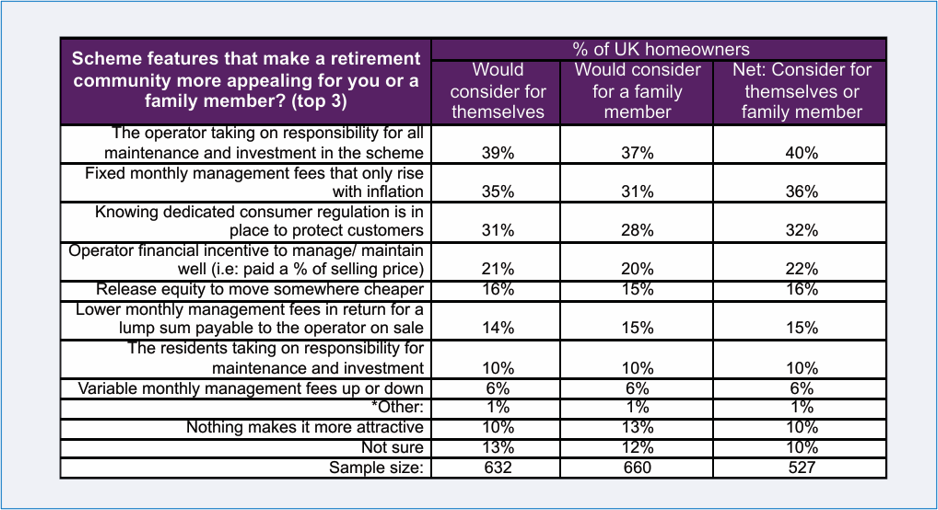
It's why operators have leaned so hard into the fixed monthly fee. It sells. And the research backs it: when ARCO and the HomeOwners Alliance asked what would make later-life housing more appealing, the answers were strikingly consistent.
CAPTION: Key features that can make a retirement community more appealing to residents and their families; Source: Blueprint New Zealand: What People Want?
Here's what buyers actually want:
- Simplicity. The operator carrying full risk and responsibility for maintenance and investment, so the resident doesn't have to.
- Certainty. Fixed monthly fees that only move with inflation. Just 6% said variable service charges made retirement communities more attractive.
- Reassurance. A member of staff on site around the clock, ranked the single most appealing service of the lot.
So the commercial logic is sound. Predictable ongoing costs win the sale, gives reassurance to family, and sets IRCs apart from other leasehold models. But that same number, so reassuring on the brochure, is doing an awful lot of quiet work once it reaches the ledger.
Anatomy of the five lines
So that one tidy number is quietly doing the work of several. The obvious next question is what, exactly, it's hiding.
So let's look properly at that one tidy number. Once you break it apart, it stops being a single payment and becomes five different income streams sitting together. Each one arrives on its own terms. Each is taxed differently, recognised differently, and follows a different set of rules. Here's how they behave once they reach the books:
- Rent, or occupancy. The part property teams know well. From 2026, though, even this changes, with most leases now recorded on the balance sheet rather than in the P&L.
- Care fees. Regulated, delivered over time, and often part-funded by someone other than the resident. The income is recognised as the care is provided, not when the invoice is raised.
- Personal support. The discretionary extras. They vary month to month and resident to resident, so they are rarely neat or repeatable.
- Catering. A service rather than a tenancy. That makes it a separate promise in its own right, with its own timing.
- Ancillary items. Guest suites, transport, the occasional social event. Small sums, irregular, often seasonal, and recognised at the point they are used rather than spread across the year.
Five lines, five sets of rules, one resident payment. For an IRC operator, that payment can include accommodation, service charges, wellbeing services, hospitality and a range of ancillary offerings. Each must be accounted for differently, despite appearing as a single charge to the resident.
That is what makes IRC finance different. The challenge is no longer just occupancy and property accounting. It is managing multiple revenue streams across housing, hospitality and care, while maintaining transparency and compliance. Property finance expertise remains essential, but on its own it was never designed for the complexity of the IRC model.
What actually changed in 2026
Splitting the fee into five lines has always been fiddly. This year, it stopped being a matter of good practice and became a matter of the rules. Here's the part most operators haven't fully clocked yet: the rules for counting all this quietly changed this year.
- The first full update to the Housing SORP since 2018.
- Income is now recognised on the basis of control, using a five-step model.
- The changes are most relevant to housing associations and registered providers rather than private operators.
- For retirement living organisations that fall within that category, especially those managing bundled service charges, the update increases the importance of consistent income recognition and reporting.
- Introduces a single, comprehensive five-step model for revenue from contracts with customers.
- Applies to accounting periods beginning on or after 1 January 2026.
- Most leases now sit on the balance sheet rather than in the P&L.
Now, why does this land on senior living harder than most?
Because for the majority of operators, the first reporting year under these rules is the one ending 31 March 2027, with a transition date of 1 April 2026. That means the opening balances are being built right now. This is not a disclosure tweak to worry about later.
It forces operators to formally separate that single fee into its component promises and then justify how each one has been recognised. A finance team built for lease reconciliations and void periods is now being asked to allocate a transaction price across five obligations and defend the judgement. Those are two very different jobs.
Where it breaks, and what it costs
New rules are one thing. What they do to the numbers your board actually watches is quite another. None of this would matter much if the stakes were small. They aren't.
When revenue is misstated or costs land in the wrong category, the damage doesn't stay in the accounts. It shows up in the numbers the board actually watches. Net operating income drifts. Unit economics blur. And the picture you're reporting stops matching the business you're running.
Then there's the covenant question. The 2026 lease changes pull most agreements onto the balance sheet, and that feeds straight into EBITDA and interest cover. For any operator with lender agreements in place, that is a conversation worth having early rather than late.
Now put it against the margins. Across the retirement housing sector, operators are balancing rising operating costs, evolving resident expectations and increasing regulatory scrutiny. In that environment, accounting accuracy becomes a commercial necessity rather than an administrative exercise. A categorisation error isn't a rounding issue. It's a margin event.
And this is happening at scale. If the sector hits its ambition of 250,000 people in housing with care by 2030, it points to over £70bn of turnover. That is a great deal of revenue about to be recognised under rules built for something far simpler than senior living.
The missing capability
So what actually closes the gap? Not more hours from the same team. A different capability.
The work that senior living now demands is fairly specific. Revenue recognition mapped obligation by obligation, so each of those five lines is counted on its own terms. Community and tenancy accounting that holds up under scrutiny.
Tenancy-to-income reconciliation that ties what a resident is billed back to what has actually been earned. This is not a stretch assignment for a property-trained team. It is a separate discipline, done by people who have built these frameworks before.
It is also where the right support quietly pays for itself. Working with QX, senior housing providers typically see:
- A 40 to 60% reduction in finance operations costs, freeing up capital to reinvest in care rather than back-office overhead.
- Automation doing the heavy lifting on high-volume work like invoice processing, reconciliations and month-end, instead of adding headcount.
- Around 99.7% invoice processing accuracy, which matters a great deal when five revenue lines all have to be recognised correctly and defended at audit.
If any of this feels close to home, it might be worth a quiet conversation. We're happy to talk it through whenever the timing suits, no strings attached.
What's the Bottom Line?
So where does all this leave an operator weighing it up?
The fixed monthly fee isn't going anywhere. Residents want it, families trust it, and it will keep winning sales for good reason. That part of the story is settled.
What has changed is everything sitting behind it. Quietly, over the course of 2026, the rules for counting that single fee have been rewritten. The number on the brochure stays simple. The accounting underneath it no longer does.
For most operators, that reckoning arrives with the accounts for the year ending 31 March 2027. Which makes the months between now and then rather valuable. Not for a scramble, but for getting the plumbing right while there is still time to do it calmly.
Article Authored By:
Nishant Kumar, Vice President – UK & EMEA at QX Global Group