FOR IMMEDIATE RELEASE
In response to recent coverage in The Times examining resale outcomes within the retirement housing sector, ARCO (Associated Retirement Community Operators) has highlighted the distinct characteristics of the Integrated Retirement Community (IRC) model and the role Deferred Management Fees (DMFs) play in aligning operator and resident interests.
Notably, no ARCO member communities were featured in the article's analysis.
Integrated Retirement Communities differ significantly from traditional retirement housing models. Designed to provide residents with independent living alongside access to care, support, amenities and community facilities, IRCs are increasingly recognised as a key part of meeting the UK's ageing population's housing needs.
A core feature of many IRCs is the use of Deferred Management Fees, which enable operators to offer lower monthly management fees - thereby improving affordability - and ensure operators have a direct financial interest ('skin in the game') in maintaining high-quality communities that remain attractive to future purchasers.
The UK government has noted that DMFs “help fund the ongoing services and facilities that residents rely on and make retirement housing with additional services and facilities more affordable for consumers."
DMFs - sometimes known as 'event fees' - create a strong alignment between residents and operators, with both parties benefiting from the long-term success and desirability of the community.
Independent research into the IRC sector has found that, over the long term, average price inflation for IRC properties operating with a DMF model has outperformed the wider UK housing market.
These findings challenge common misconceptions about later living housing and underline the importance of assessing resale performance within the context of different business models and types of older people's housing.
An ARCO spokesperson said: :
"It is important that discussions about resale values in the later living sector distinguish between different housing models. Integrated Retirement Communities are fundamentally different from traditional retirement developments, and Deferred Management Fees ensure operators have genuine skin in the game when it comes to maintaining quality and supporting long-term value.
The evidence demonstrates that IRCs can deliver strong outcomes for residents while providing the lifestyle, wellbeing and care benefits that older people increasingly seek."
ARCO continues to advocate for greater awareness and understanding of the IRC model, which is already well established in countries such as New Zealand, Australia and the United States, and which has a vital role to play in expanding housing choice for older people across the UK.
NOTES TO EDTORS
-
The Times published ‘We lost more than £225,000 on Mum’s retirement home’ on Thursday 23 July, 2026.
-
The government noted in its Guide to the Draft Commonhold and Leasehold Reform Bill (2026) that Deferred Management Fee / event fees “help fund the ongoing services and facilities that residents rely on and make retirement housing with additional services and facilities more affordable for consumers."
-
The Knight Frank Seniors Housing Trading Performance Review 2025/26 notes that " in the long run average price inflation for IRCs with a DMF has outperformed the wider UK housing market." See: seniors-housing-trading-performance-review-202526-12554.pdf
-
ARCO is the national membership body for charity, not-for-profit and private operators of modern housing-with-care schemes, known as Integrated Retirement Communities (IRCs). ARCO provides a voice for the sector with government and sets standards for the sector via the ARCO Consumer Code, which has been approved under the Chartered Trading Standards Institute’s Approved Code Scheme.
-
IRCs are modern housing-with-care schemes for older people – modern because they embrace a holistic approach to services, facilities, community and wellbeing. All IRCs include: 24/7 on-site support; a restaurant/bistro/café, usually with a bar; individual units with their own front door, kitchen and lounge; communal facilities such as gyms, craft rooms, lounges and gardens; and, Personal care at home if it is required. The average age people move into an IRC in the UK is around 80 and the average duration of residence is eight years. In addition to the features above, IRC operators offer deferred management fees (sometimes known as ‘event fees’ or ‘exit fees’) in order to enable lower monthly management fees and take on long-term responsibility for maintenance and investment. Unlike traditional retirement housing (which typically use variable service charges and a sinking fund), deferred management fees give operators a direct financial incentive in the resale value of a scheme ('skin in the game'). Independent evidence shows that the use of deferred management fees supports positive resale values.
-
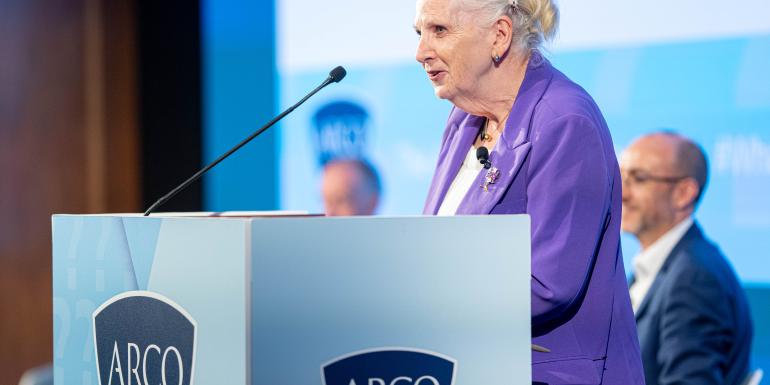
Baroness Taylor, Parliamentary Under-Secretary of State at the Ministry of Housing, Communities and Local Government, recently told the ARCO Annual Conference (01 July, 2026) that Integrated Retirement Communities "have such an important role to play in offering people a more supportive environment as needs change over time. And when the system is working well, the benefits extend beyond individual households. There are much wider benefits, of course, across our health system, our housing market, our society as a whole. And as a government, we're trying to look in a much more holistic way about how we deliver across all of those agendas with public service transformation. So, first of all, on health, we know that suitable housing plays a vital role in keeping people well. It reduces falls, it reduces hospital admissions, and it helps prevent delayed discharge by making sure people have somewhere appropriate to go back to. Second, on the housing market, many older households are living in homes that are larger than they now need. If we can offer attractive, appropriate alternatives, we can support people to move in a way that works for them, freeing up family-sized homes for the next generation. And third, for communities, because well-designed homes for later living can play a vital role creating mixed, intergenerational neighbourhoods – places where people of different ages live alongside one another, and that really does support stronger local connections. Which is why housing for older people matters not as a niche part of the system, but as part of how the system works as a whole."
-
Matthew Pennycook MP, the Housing Minister recently told MPs (13 April, 2026): “… the Government understand the distinct operational and financial models that underpin specialist retirement housing, and that we recognise the important role that integrated retirement community operators play in providing high-quality housing for older people." https://hansard.parliament.uk/commons/2026-04-13/debates/51CD692E-9426-452B-AB3F-40AD74D25FEA/LeaseholdReformIntegratedRetirementCommunities
-
Contact: 07535 088498 or policy@arcouk.org